Industry News
Industry News
Aug. 05, 2026
Key points:
Indonesia is a strong growth market for padel, but its tropical rain, heat, humidity, and intense sun make uncovered courts less predictable. Covered padel courts help clubs protect booking revenue, reduce surface wear, improve comfort, and offer a more premium experience. For Jakarta, Bali, Surabaya, Medan, and resort destinations, a covered or semi-covered design can turn weather risk into a competitive advantage. Fortune provides covered padel court solutions for tropical and high-rainfall markets.
Indonesia has a young urban population, a growing middle class, strong mall and lifestyle culture, and a large hospitality sector. These are all positive signals for padel. The sport is social, easy to learn, and attractive for clubs, resorts, residential communities, schools, and mixed-use developments.
But Indonesia also has one obvious challenge: weather. A facility business depends on playable hours. If rain interrupts peak evening bookings, the club loses revenue, customers lose routine, and staff must handle rescheduling. Covered courts are not just a comfort upgrade; they are a business model upgrade.
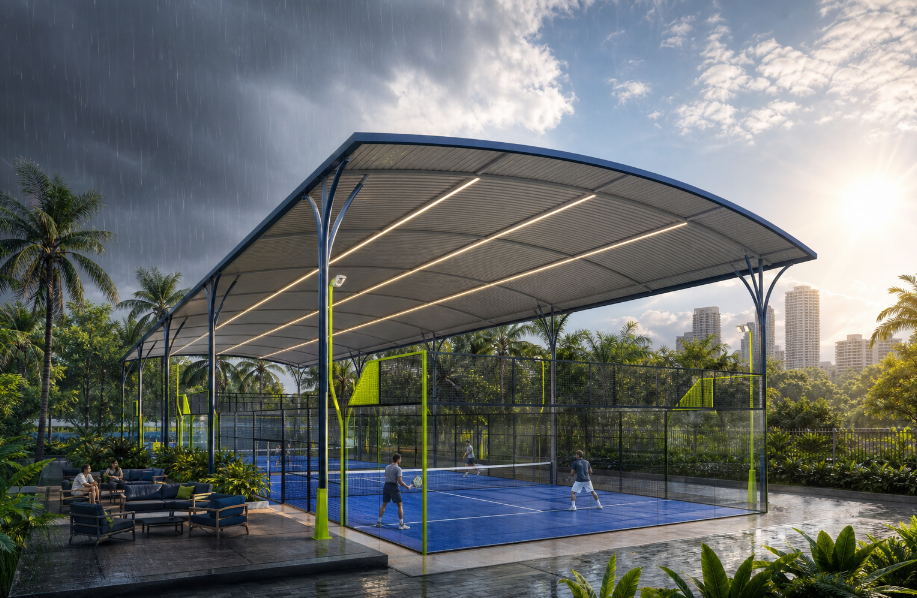
Indonesia’s climate is tropical, with heavy rainfall in many regions and strong seasonal patterns. Outdoor padel courts can dry more quickly than some traditional surfaces, but they are still affected by heavy rain, slippery glass, wet turf, puddling, and player safety concerns.
For a club, the important number is not annual rainfall only. It is rainfall during bookable hours. If storms hit after work or during weekend peaks, even a beautiful uncovered facility can lose its best revenue windows.
Weather Factor | Impact on Uncovered Courts | Covered Court Advantage |
Heavy rain | Cancellations and rescheduling | More playable hours |
Strong sun | Player fatigue and lower comfort | Shade and better experience |
High humidity | Slower drying and more maintenance | Better surface protection |
UV exposure | Faster aging of turf and coatings | Longer material life |
Tropical storms | Operational disruption | Better asset protection with engineered design |
A covered padel court can be designed in several ways. Fully indoor halls offer the highest weather control, but they require more investment, ventilation, lighting, and building approvals. Semi-covered or canopy-style courts can protect against rain and sun while keeping natural airflow.
For Indonesia, open-sided covered courts are often attractive because they balance comfort, cost, and ventilation. They can fit resorts, rooftop clubs, lifestyle centers, and sports parks. The roof design must still consider wind, rain direction, drainage, lighting, height clearance, and local permitting.
Players do not only want a court; they want a reliable plan. A covered court lets them book after work without worrying as much about rain. It also makes coaching programs, corporate events, tournaments, and memberships easier to sell.
For premium clubs, the cover becomes part of the brand. It signals that the facility was designed for serious operation, not installed as a temporary trend. A roof can also improve lighting consistency, reduce glare, and create better content for social media.
Rain and UV exposure affect the court system. Artificial turf, steel coating, lights, electrical components, fasteners, nets, and glass fittings all benefit from reduced direct exposure. Covered courts may have a higher upfront cost, but the long-term maintenance profile can be better, especially in high-rainfall regions.
This does not mean a roof removes all maintenance. Humidity still matters. Drainage still matters. Airflow matters. But the court is no longer taking the full force of every storm.
The financial case is straightforward: a covered court can generate revenue on days when uncovered competitors are closed. If a club loses several peak sessions per week due to rain, the roof can recover part of that lost income.
Revenue Driver | Why Covered Courts Help |
Memberships | More reliable access increases perceived value |
Coaching | Fewer canceled lessons |
Tournaments | Lower event weather risk |
Corporate bookings | Better scheduling confidence |
Resort guests | Premium all-weather amenity |
For Indonesia, covered courts can be especially useful in mixed-use projects where customers expect a polished lifestyle experience.
Before ordering a covered padel court, investors should prepare:
Wind and rainfall assumptions for the project city.
Roof height and ball-clearance requirements.
Drainage routes and gutter planning.
Ventilation strategy for heat and humidity.
Lighting layout under the roof.
Local permit and land-use requirements.
Access for cranes, containers, and installation teams.
Fortune can help early-stage investors review layout options and match panoramic padel court designs with canopy or covered structures.
Covered courts are especially suitable for Bali resorts, Jakarta lifestyle clubs, rooftop sports venues, universities, private communities, and high-end commercial clubs. They are also useful where land rent is high, because every playable hour matters more.
For smaller investors, a phased approach can work: start with two or four courts and design the site so additional covers or courts can be added later. This avoids overbuilding while keeping future expansion possible.
Indonesia does not just need more padel courts. It needs more weather-smart padel courts. Covered designs help clubs operate more consistently, protect the investment, and create a better player experience in a tropical climate. If the goal is long-term revenue rather than a short-term trend, covered courts deserve serious consideration.
International Padel Federation, Rules of Padel: https://www.padelfip.com/
ISO 12944, corrosion protection for steel structures in humid and aggressive environments.
ASCE/SEI 7, minimum design loads and associated criteria for buildings and other structures.